
Can a pastor be politically neutral?

I realize in writing this and posting it to this blog, I’m declaring something that many will object to.  I also realize that for the majority of my time in ministry, I have avoided saying what I really think or feel.  I ask that if anyone reads this, you would prayerfully discern how human I really am and the tension to be a shepherd in God’s kingdom, not a political leader in our society – although I admit there should and will be intersections of both realities.

After the events of January 6 in Washington DC, my daughter looked at my wife and me and said, “so, obviously you’re Democrats, right?”  I could see how the language and word choices of our conversation about what happened that day had led her to believe this.  Without hesitation, I told her, “no, I’m independent.”  And then I tried to explain how every election is a crisis of moral conscience – and how nothing is black and white for me. 

I once polled a Sunday School class I was teaching with the question, “should a pastor his/her voice political concerns?”  The response was an obvious 50/50 split.  Therein lies the conundrum for me.  On one hand, “politics” simple means issues surrounding society and people.  On the other, “politics” assumes a party agenda – a slate of issues that one group finds agreement on. 

Now, for most contexts of the Church, we find ourselves in conversations surrounding morality.  We look for biblical guidance and its authority to discern God’s opinion on our world.  And then we try to live in that opinion, aka “His will”.   When it comes to the array of issues with abortion, civil rights, human sexuality, immigration reform, economy growth, healthcare, and foreign relations, the Bible is not silent.  But how people interpret the contexts and applications are debated on scholastic and more personal levels.  This means that our Church’s leaders are going to find common ground and opposing viewpoints. 

From a pastoral standpoint, we ask ourselves when nurtures God’s people.  And sometimes we ask ourselves what protects God’s people.  For the true image of a pastor is found in the biblical imagery of a shepherd.  Jesus himself declared that a good shepherd will lay down his life for his sheep (John 10:11).  In professing to be the “good shepherd” – meaning the most accurate representation of God’s leader.  Peter wrote that God’s people have returned to the Shepherd and Overseer of your souls. (1 Peter 2:25)  Invoking this same language, my friend Andy – who is a pastor – recently wrote to his congregation:

I don’t think that pastors should tell people how to vote. My concern here is not the endorsement of political parties. Both of our major political parties are imperfect – neither fully represents a faithful embodiment of the Scriptures. My concern here is that a wolf has walked into the pasture and convinced the residents that he’s a sheep – without even putting on a wool sweater! For some reason when the sheep listen to the wolf, they think he sounds like the Shepherd. As one of the herd dogs, I’m ashamed that I haven’t been barking loud enough.

Citation available by request in order to protect this pastor.

The rub for the pastor who identifies as a shepherd is “when do I bark?”  When do I say “this is wrong” or “watch out, a wolf is on the prowl”?  When evangelical leaders threw their hat in with Donald Trump, I was admittedly confused.  His demeanor and accusations did not resonate with the Kingdom of God nor could this be said of the other candidate(s).  And for four years, I’ve watched time and time again as his supporters dig up rationale for his behavior.  He divorced himself from facts and championed his authority over courts, elected officials, and constitutional procedure.  Even then, I remained silent because his character was always congruent with such immorality. 

But on January 6, his staunchest supporters waved “Jesus 2020” flags and behaved with such irrationality that no one thought their mania would reflect poorly on the name of Christ.  Such is the psychology of groupthink and an arrow in the quiver of spiritual demons.  I want to be clear that my battle to remain politically neutral still persists.  I am not convinced of one party’s altruism over another’s.  Instead, I rely on the knowledge of the Lord Jesus as my and our salvation. 

If you’re reading this, it’s because you know me or you’re trying to get to know me.  And in the hopes of developing as a pastor, I ask for your prayers – for me and the other colleagues in ministry who trying to navigate these waters without succumbing to cowardice.  On such days as these, political neutraility is not optional. And so, to answer the question posed in the title: No. I do not believe a pastor will always be able to remain neutral. On most occasions, I believe it best to avoid political debate, remaining party-neutral. And in agreement with my friend, I will never tell people how to vote. But I will also never remain silent when my sheep need protecting.

I long for the day when all is made clear on the Day of the Lord and His kingdom truly comes to reign on this world forever.  Until then, I remain faithfully hopeful … and a lot more cautious of wolves in sheep-clothing. 

The God who sees me

Do you have someone in your life who “sees” you?  I mean, really sees you?  I’m convinced that if we do have such a person in our lives, then we merely have a glimpse of what our Heavenly Father offers us. You see, we all have these souls that need nourishment.  Being created that way, we confess that God is the only One who can detect everything our soul needs and then meet every one of those needs.  

In Genesis, we read of a woman who was so disregarded and unseen. This woman – Hagar – had been used, mistreated, and neglected.  As she runs away from her pain, she receives the grace of God when an angel reminds her of how precious she is – and the life of son.  Fully aware now of God’s affection, she cries out “You’re the God who sees me.  Truly I see the One who sees me.”  (Gen 16:13)   

May Hagar’s testimony encourage you to come before the Father with eagerness to be fully seen and known.  And there before Him, may you see and know Him.

Do you long to be seen by God?
    Do long to fix your eyes on Him…who sees you?
In being seen…are you ready to simply let Him take care of your soul in every way?  

This is the love he bestows upon us: 
    “not that we loved God, but that he loved us and sent his Son as an
     atoning sacrifice for our sins.” 1 John 4:10

You are seen. You are loved.

What makes a story captivating?

Every summer movie production companies bank on the fact that consumers love to be entertained.  For years, they’ve poured billions of dollars into new stories to capture our imaginations.  The twist in recent years is that new stories are not as profitable as sequels and remakes.  In their studies of the movie-watching-consumer, they’ve found that we will spend more money and time on stories that are familiar to us… or stories that connect us to something we’ve already experienced.

If you look at Jesus’ teachings, he draws in each listener to an established principle or illustration we can find in farming, shepherding, treasure-seeking.  He – like those movie producers – employ that ancient art of the parable.  Jesus’ masterful parables often pivot the often-expected focus or protagonist to a new direction (i.e. the Samaritan or an extravagant Father who forgives too much.)  When he does this, it’s controversial and exhilarating. 

In short, Hollywood spent millions to discover what a first-century rabbi demonstrated each day: every soul longs for its Maker.  Such a longing takes shape in forms of elaborate quests, romantic pursuits, dramatic transformations, and epic battles between good and evil.  It resonates with us – even those who know the Name of Christ and the great treasure we have found in Him.

So what does this have to do with those belonging to the faith?  Simply put, we have a precious Story to tell… and everyone needs it…and to some degree wants it.  We should never think for a second that the message of Jesus has an expiration date or has somehow lost its relevance.  No, we (like the Apostle Paul) “preach Christ and Him crucified” (1 Cor 1:20-24) because it’s the central theme of humanity’s existence; we were made by Him and for Him.

Do you know of the great depth and love of the Redeemer?  If so, you have His story to tell.  Now…who is God laying on your heart who needs to hear it?

The art of listening

I used to think I was a good listener.  Leading groups and meeting with folks one-on-one often provided me the opportunity to hear significant stories and I thought I had what it took to listen.  But then, I met someone who listened.  Really listened.  It caught me off guard enough to ponder about what kind of listener I am.  I wonder if you’ve thought about listening lately…?

We now live in a world where everyone who has something to say can have a platform of their own to say it via social media.  And if you don’t like the thing one person says, you can veer off and deliver your own message.  Or potentially worse, “comment” back and deliver a heartfelt disagreement, often triggering a back-and-forth that leaves the realm of “healthy conversation” and devolves into something ugly.

The art of listening is more crucial now than ever.

Author and podcaster Carmen LaBerge recently spoke to our Presbytery’s leaders and suggested that we have an opportunity to show this world something graceful and beautiful when we invite someone to “tell me more”.  Think about it.  If someone is hurting, you can invite them to reveal more about their burden.  If someone is worked up and ready to rant, you can acknowledge their frustration and let them feel heard – even if their argument isn’t valid.

“Tell me more” isn’t a magical phrase.  It won’t heal what is broken or silence ignorance.  But it can demonstrate a counter-cultural movement to this world that listening isn’t dead and that the true people of God are not here to shove a message down their throat.  Instead, It can help us invite others into our lives and help us earn the opportunity to speak truth and grace.

The messiness of life

Early in my Christian life, I stumbled upon a devotional book from Chuck Swindoll, Growing Strong in the Seasons of Life.  The premise of these writings was to guide followers of Christ to experience the promises of truth and grace when we find ourselves in seasons of reverence (winter), renewal (spring), rest (summer), and reflection (autumn).  These categories, of course, are not meant to correspond with the literal seasons of the calendar, but those seasons of life we find ourselves in spiritually.

The stories that Swindoll shares remind me that God is not afraid to dive into this season with me – whichever it may be.  When I am alone, he sends his Spirit and community.  When I am seeking nourishment, he speaks his Word into my life.  When I need rest, he invites me to come and be at his feet.  When I am too self-focused and self-absorbed, he reminds me that his Son has given me life and teaches my soul gratitude.  This messiness is what the Kingdom of God is all about.  God steps in…speaks in… reaches in… abides in those who profess faith in the Savior.

Our community can learn so much from God’s faithfulness and willingness to step into the mess, can’t we?  We know of someone who needs an encouraging word or phone call.  We have causes of justice that create such discomfort in us, that we know we ought to speak or act.  We see all around us examples of how people place their hope in possessions or position in society.  Yet, we know a Savior.  We know the Name of the one who boldly took our place of punishment so that we might have life.  We have much to offer this messy world!

Be encouraged in whatever season you find yourself in that God is right there with you.  After all, Jesus said, “I have told you these things, so that in me you may have peace. In this world you will have trouble. But take heart! I have overcome the world.” (John 16:33)

Do you love me?

One of the most haunting scenes in Scripture to me is the conversation that Jesus has with Peter at the end of the Gospel of John (21:15-19).  Three times Jesus asks the question, “Do you love me?”  I’m reminded of this scene as we move through The Jesus Creed and are consistently being invited to reflect upon, declare, and demonstrate our love for God and others.

Most scholars see the three-fold re-affirmation of Peter’s love as a contrast to his three-fold denial days earlier.  If the scene with Peter and Jesus feels awkward and oddly repetitive …and you find yourself experiencing the angst of Peter as he declares, “of course I love you!” then be comforted in knowing that the awkwardness is the point.  We too find ourselves hearing the repetitions of themes and questions and if can feel laborious to return to our same ol’ answer. Sometimes it’s our shame or fear that keeps us from drawing near the Savior.  Like Peter, we need not hear Jesus’ questions as a “shame on you” but more as an “are you ready to come home?”

Take heart, dear church!  Jesus knows the Abba’s heart so well that he wants to convey his never-ending, never-exhausted love, never-second-guessed love to all of us who need to be invited back.  Let us return to the feast with Jesus and confident in his reception.  Then, listen to His voice and trust that he will use us to reflect his love to the world.

Social media and the pastor’s conondrum

I am not the most social-media-savvy pastor.  I don’t tweet pithy alliterations or wise mantras for the masses.  It’s not me and it probably never will be.  But I do try to stay aware and use the tools of social media to articulate hospitality and hope.  And yes…I occasionally post ridiculously cute pictures of my kids.  My struggle with these platforms is what to say or do when something political strikes a chord with us.  I fight temptations to say something so much that I want to scream but am silenced thankfully by a Spirit of peace and wisdom.

Dear reader, I can’t even give you an example of such an instance because I know that it could incite an unneeded debate…and let’s be honest, are those online debates even worth it?!   Some pastors and ministry leaders step into the mire and deliver heartfelt responses.  I get it.  I really do.  Perhaps it appeases a great number of their congregation, but it undoubtedly alienates some.  Imagine those readers hearing the words of their shepherd chime in on gun laws, civil rights, immigration reform, or alas, POTUS tweets and being hurt, misunderstood, confused or lobbied to a political perspective.  I have imagined it.  I have read them.  And I am heartbroken for either side who cannot stomach what they read from someone they trust to speak God’s Word.

In my battle, I continue to err on silence – usually after commiserating with my wife – but ultimately believing that if I don’t have God’s Word to speak on the issue, I am to be silent on the matter.  This idea was first communicated to me from Henry Blackaby who spoke at a conference on The Power of the Call.  When speaking of the call of Moses, he pointed to Moses’ inability to communicate clearly (really, just one of his many excuses) but to the soon-to-be-prophet heard this:

“Who gave human beings their mouths?  Who makes them deaf or mute?  Who gives them sight makes them blind?  Is it not I, the Lord? Now go; I will help you speak and will teach you what to say.”   (Exodus 4:11-12)

Blackaby’s point was that we are to speak what God gives us to speak.  He went so far to say we should only speak what God gives us to speak.  Woah.  What a radical call!  Imagine ONLY saying what God wants you to say!  The idea it intimidating and the weight of responsibility is immeasurable.  But at the same time, imagine the sense of freedom.  There is no worry of saying the wrong thing… because you’re just saying what God says.  It’s terrifying and beautiful.  And this world needs more mouthpieces of God, not more pithy tweets.   (And yes, I realize the hypocrisy of this post on a social media platform.)

In Moses’ story, he finally relents as God promises to speak through him and his brother, Aaron, and he sets off to deliver the message of freedom to Pharoah and the Israelites in bondage.  That should be my task: deliver God’s voice of freedom.  Perhaps that should be every pastor’s social media gut-check.

If I fail at this, dear friends, remind me to return to the call.  And if this encourages those outside of the vocation of ministry, then welcome to the mission of speaking life into the darkness.

The Goal of Groups

With all the different types of groups at WPC, it’s helpful at the launch of a new season to remember that groups have a goal.  Think about it, every group has a goal: the choir leads in artistic worship, a basketball team plays to compete and win, and a youth group provides challenging and dynamic experiences for youth to begin their faith journey.

So what is our goal for adult small groups? Simply put, it’s GROWTH. Spiritual growth is the follower of Christ’s endeavor to become more like Him and live missionally in the world that He died to save.

Now, the realistic challenges of each group are numerous. Irregularity changes the ability to fellowship consistently.  A growing and robust size changes the ability to experience personal depth.  And time… time is always the enemy of groups!

A quick test for every group should be are we growing?  If we are growing spiritually, then our faith seems stronger, our knowledge of God is richer, and our personal application of study becomes increasingly practical.  If we are growing missionally, then our groups shepherd one another in life’s difficulties and joys and we are introducing others to Christ in our community. If we are growing in size, then our community is multiplying!  With multiplication, however, comes NEW groups – with new facilitators, fresh voices, and resources.  We try new things.  We let others step into the gap to live out their giftedness and be used by God.

So my friends, let’s ask the question about our groups…are we growing?  I anticipate that many of our groups will say “YES!”  And if we say “not quite” then let’s boldly ask God to help us get on track!  


Fragile faithfulness: Reflections on my Peru trip

Every now and then I find myself voicing a defense of short-term mission trips.  It has been suggested – even thoughtfully articulated by some – that it would be better to financially support a ministry abroad rather than flow thousands into getting North American Christians to get a weeklong experience.  That cringeworthy term “voluntourism” just rings of wealthy, entitled kids and adults getting a “fix” of service before returning to normal life.

As many of you know our 13+ year relationship with the Dominican Republic has shown that we support short-term mission work.  We believe that ongoing partnerships equip local leaders, support their vision, and inspire risk-taking, cross-cultural relationships.  Last week I visited Santa Clara, Peru a small village outside Iquitos in northeastern Peru.  As we stepped off the Amazon River boat-taxi, I was immediately surprised at the quiet atmosphere within the village.  No bustling market.  No revving engines from motorcycles.  No shouts from children or adults for our attention.  Just the breeze in the air and a few toucans squawking in the distance.

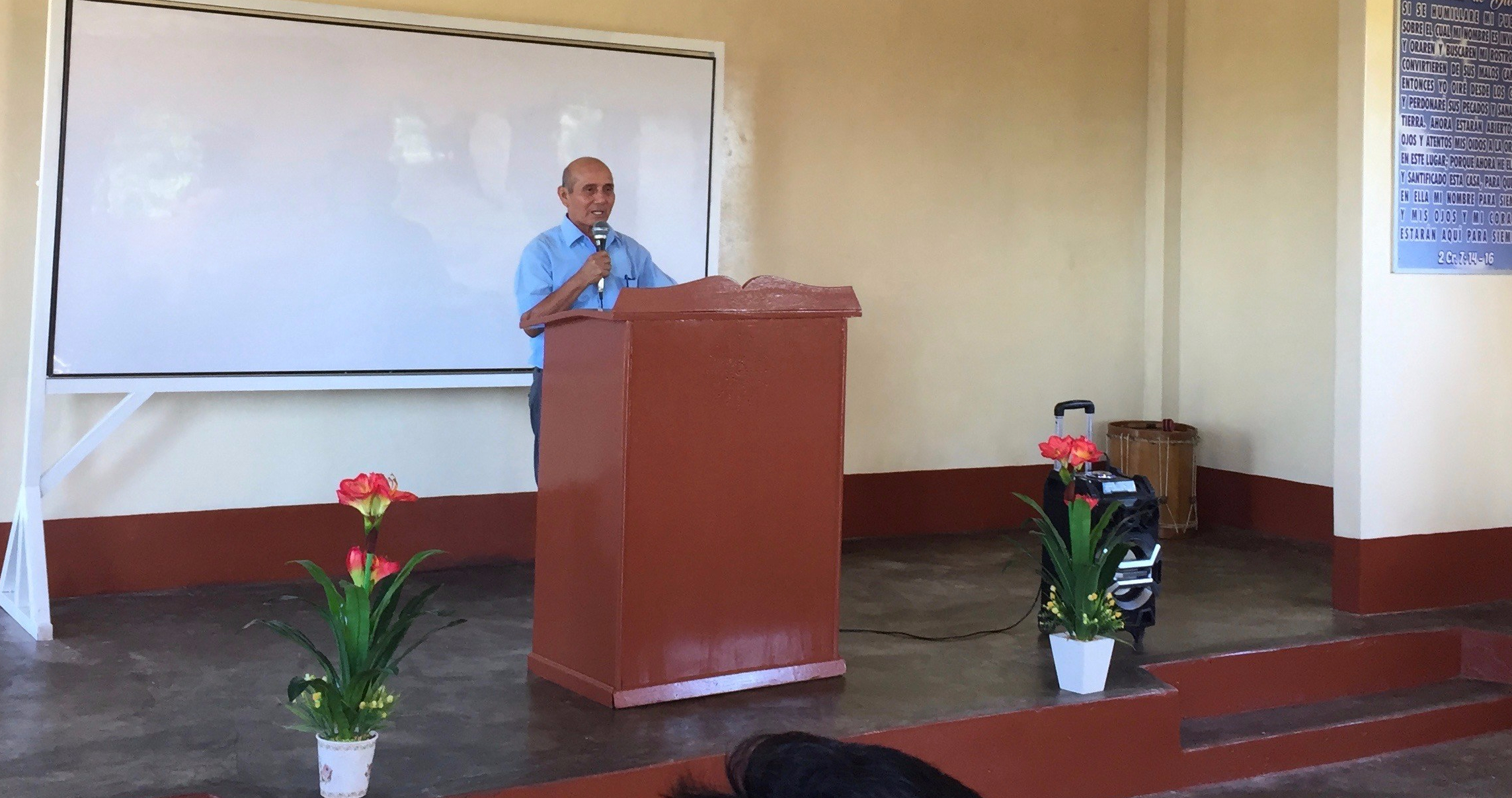
IMG_9929.jpgWe met the pastor of the small community – Pastor German (“Herman”) and his wife, Enith, and began preparing for the local church service.  From that morning and throughout the next few days, I was perplexed at the small size of 8 or so adults attending services or classes.  There were very few young adults, a couple of teenagers, and around 30 children.
Why was I disappointed with such a small crowd?  Comparing one mission experience to another might be the reason.  But I think there’s another: I’ve been hearing about the ministry partnership of Westminster and this community for 6 months – and understanding that it’s the result of 15+ years of annual trips, projects, and outreaches.  So after all this time, I thought there would be “evidence” of the investment. Sure, I met folks who were active – even one man who is a new believer and becoming a vital part of the community and church.   And he is awesome!  But I was left with a nagging curiosity to uncover something else.

Pastor German
Pastor German preaches on a Sunday morning in Santa Clara

It took all week – really until the last day – for me to understand the call we have to this ministry.  As Pastor German rose to share parting words and to honor Dr. Paul for his 16 years of trips, he shared a story of a ministry-friend who had once been close but stopped coming or calling German in the recent years.   “I hope we do not lose touch,” he said as he reflected on the blessing of their partnership.  With gratitude and a tinge of sadness, he and Paul said their goodbyes.  The mantle of “trip pastor” was being passed to me…and I finally understood what I was there to witness and bring back.

You see, this man (and his wife and family) had been faithfully serving this community for years.  This calling they have carried is one of loneliness, harsh criticism, rejection.  There was never a moment of radical growth.  Just families who came and went. It’s a ministry filled with fragile faithfulness – one that the enemy teases and pokes until others in ministry would normally walk away.  I think I would have!  But…

He has never walked away.

So God says, “you won’t either, Justin.”  Supporting this man of God means that as long as the Lord allows it, we will endure with him.  We will suffer through the disappointments.  We will celebrate the new believers.  We will build a fence, assemble some water filters, or teach some classes.  We will go.  We will listen to the vision and we will beg heaven to chase every person down in Santa Clara.

It will seem foolish to many.  I’m sure I will even have my doubts some years.  But we partner and support this Pastor.

I can’t wait to get to know Pastor German more – and the family and friends who will continue living out the Gospel in Santa Clara.   And I will keep asking God to give us the faithfulness to walk with them.

Learning to Pray

I’ve always found prayer to be one of the spiritual disciplines that everyone wants to improve on.  We often think of prayer as the times we give God our words and thoughts.  Sometimes we mistakenly try to “update” God on the comings and goings within our minds and neglect the truth that his omniscience clarifies this thinking as foolish.

So then, what are we doing when we pray?  We are entering before “God’s throne of grace with confidence, so that we may receive mercy and find grace to help us in our time of need” (Hebrews 4:16)  This is done in full participation of the Godhead: the Spirit delivers, the Son presents, the Father hears and blesses.  This holy dance happens as we pray and somehow experience the cosmic interplay of power, humility, and glory.

I confess that so often I pray because I want to change God – change his mind or move him to act on my behalf or my loved ones.  The reality, of course, is that prayer – true prayer that is aligned with the will of God – will often change me. 

What if we began to pray with this assumption and posture?  What if we as a church prayed expectantly and with hope that the discipline of prayer is not a checklist or debrief of the day?  Instead, I submit, we offer our hearts to God and ask for his Voice to change us.  Not only would this change our private prayer life, but doing this in community (small groups) might lead to richer times of prayer together.  Try asking questions of God and allowing space or silence to wait.  Read the psalms as corporate prayers – as they were intended.  Pray the Lord’s Prayer or psalm as a group and in your own words.  Have someone keep up with answered and unanswered prayers in a group journal, revisiting past entries for celebration or for persistence.

Prayer – both corporately and privately – can truly transform your life and your understanding of God.  Richard Foster once wrote, “In prayer, we begin to think God’s thoughts after him: to desire the things he desires, to love the things he loves, to will the things he wills.”  In this way, we pattern our lives after our Lord Jesus and become more like him as well as more intimately know and be known by him.